EN
 Čeština
 Deutsch
 Français
 Italiano
 Español
 Nederlands
 Polski
 Ελληνικά
 Hrvatski
 Slovenčina
 Português
 Türkçe
 Svenska
 Magyar
 Română
How AI Parking Detection Stops Revenue Leakage
Most parking operators and marina managers know they are losing money. The question is how much, and why.
How AI Occupancy Detection Helps You Stop Losing Revenue on Your Parking Lot or Marina
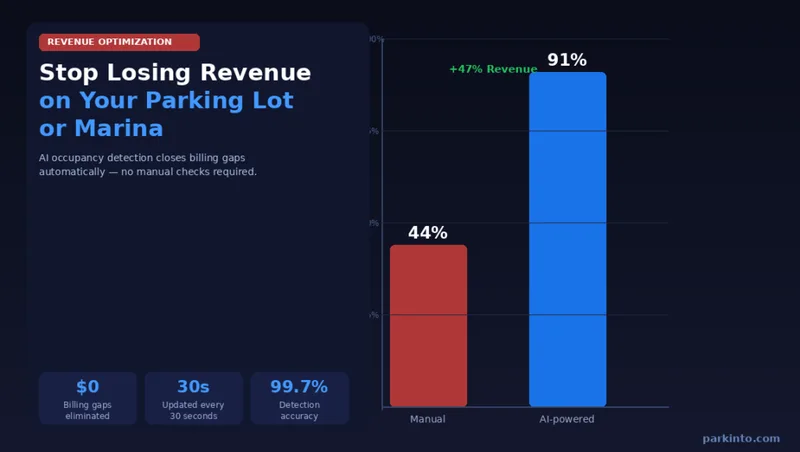
Most parking operators and marina managers know they are losing money. The question is how much, and why. The answer is almost always the same: a lack of reliable, real-time occupancy data leads to billing gaps, overstays that go undetected, and decisions made on guesswork rather than facts.
AI-powered occupancy detection changes the economics of parking management by turning an inconsistent manual process into an automated, data-driven operation.
The Problem: Invisible Occupancy Means Invisible Losses
In a traditional parking setup — whether a city lot, a hotel car park, or a marina — billing is often based on entry/exit tickets, manual checks, or payment machine records. Each of these methods has gaps. Drivers leave without paying. Boats stay beyond their booked duration. Reserved spaces are occupied by unauthorized vehicles.
Without a system that continuously monitors actual occupancy, these losses are essentially invisible. They show up only in aggregate as lower-than-expected revenue, with no way to diagnose the root cause.
How AI Closes the Gap
An AI occupancy detection system like Parkinto monitors every parking space or berth continuously, capturing the actual state of occupancy every 30 seconds. This creates a persistent, timestamped record of exactly when each space was occupied and for how long.
For a marina, that record is the basis for billing: Parkinto Marina charges each stay from real berth usage, including overstays. For a car park, Parkinto does not handle payments; the same record shows which spaces are occupied, for how long and which are over the time limit, and your payment or enforcement system can use it through the API and webhooks.
Specific Use Cases Where Revenue Leakage Is Eliminated
- Overstay detection:The system flags any vehicle or vessel that has exceeded the maximum stay set for it, enabling prompt action before the overstay compounds.
- Unauthorized use of reserved spaces:Licence plates read by the camera are passed through the API to your access or enforcement system, which checks whether a vehicle in a reserved space is authorised.
- Accurate marina billing:Parkinto Marina logs the precise duration of each berth occupation, including boats that depart before their scheduled checkout, ensuring billing matches reality in both directions.
- Pricing decisions based on data:hourly occupancy and peak statistics show when a site is full and when it is empty, so operators can set tariffs and time limits on evidence. Applying the prices stays with the operator’s payment system.
The Data Advantage: Beyond Billing
The benefits of continuous occupancy tracking extend beyond recovering lost revenue. Hourly and daily occupancy statistics allow managers to understand demand patterns, identify underperforming spaces, and make evidence-based pricing decisions. A facility that previously ran on gut feel now has a dashboard of actionable insights.
A Straightforward ROI
At $69 per camera per month, one outdoor camera typically covers 25–35 spaces. Whether it pays for itself depends on how much revenue your site currently loses to overstays and unrecorded stays; the business case guide shows how to calculate it. For marinas with seasonal peaks and complex pricing structures, the ROI from automated billing can be even more significant.
If your parking or marina operation is generating less revenue than it should, the first step is visibility. Start with a free 2-week trial and see exactly what your occupancy data looks like in practice.