EN
 Čeština
 Deutsch
 Français
 Italiano
 Español
 Nederlands
 Polski
 Ελληνικά
 Hrvatski
 Slovenčina
 Português
 Türkçe
 Svenska
 Magyar
 Română
Parking Lot Camera Placement for Occupancy Detection
Parking lot camera placement tips for accurate AI occupancy detection in open-air lots. See height, angle, coverage and camera setup. Book a demo.
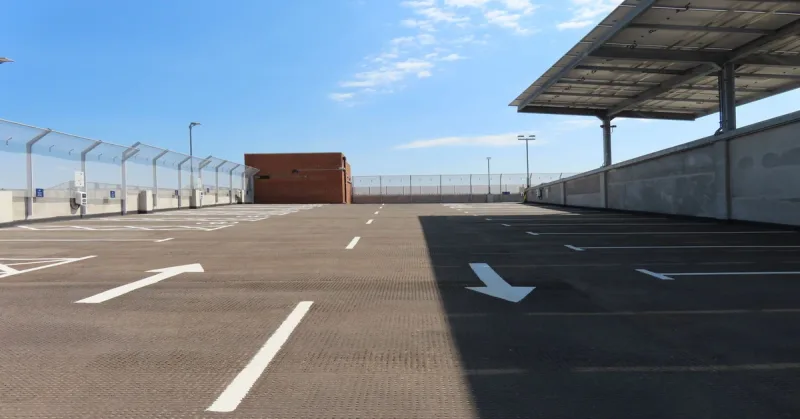
Camera-based occupancy detection is only as good as the view you give the AI. For outdoor parking lots, the best results come from a simple principle: if a person can look at the camera image and tell whether a marked space is free or occupied, AI can usually do the same. That makes camera position, height, angle and field of view central design decisions, not afterthoughts.
This guide explains practical parking lot camera placement for facility managers planning AI occupancy detection in open-air parking areas. It focuses on outdoor lots, business campuses, hotels, retail sites, truck parks and municipal parking areas where camera coverage can replace ground sensors and give live per-space data.
Why parking lot camera placement matters
Good parking lot camera placement helps the system see the actual parking spaces, not just vehicles somewhere in the scene. Parkinto works with polygons drawn over individual spaces. A space is reported as occupied when the centre of a detected vehicle lies within the polygon for that space. That means a camera should see enough of each bay and enough of each vehicle to make the free/occupied state visually clear.
Parkinto measures 99.7% accuracy for the free/occupied state per space in current operation, from a camera image captured and evaluated every 30 seconds, with the camera positioned so the occupancy is visible to the naked eye from that viewpoint. An independent measurement by the Czech Technical University put an earlier version at 99.4%. In practice, placement is one of the main controllable factors behind reliable results.
Start with the spaces you need to monitor
Before choosing a camera position, decide what the system must report. Do you need every regular space individually? Do you also need EV, disabled or private spaces shown separately? Is the goal live availability for drivers, operational monitoring, statistics, or integration into an internal system through an API?
For Parkinto, each marked space can be monitored separately. Unmarked or gravel areas can also be handled with polygons and zones, but the design should still make the parking area understandable from the image. A clear plan of spaces, rows and special-use bays makes camera planning faster and reduces blind spots.
Recommended outdoor camera height
For outdoor installations, place cameras as high as practical. Parkinto recommends mounting cameras as high as possible, with a typical ideal being a public lighting pole at about 5–6 metres. A higher position helps the camera see over parked vehicles, reduces the chance that one vehicle blocks another, and gives a better overview of the bay geometry.
Low viewpoints often create occlusion: a van, truck or SUV can hide adjacent vehicles or the line between two spaces. A higher viewpoint gives the AI a more stable scene, especially in busy lots where vehicles enter, leave and park at different angles.
Choose an angle that shows occupancy clearly
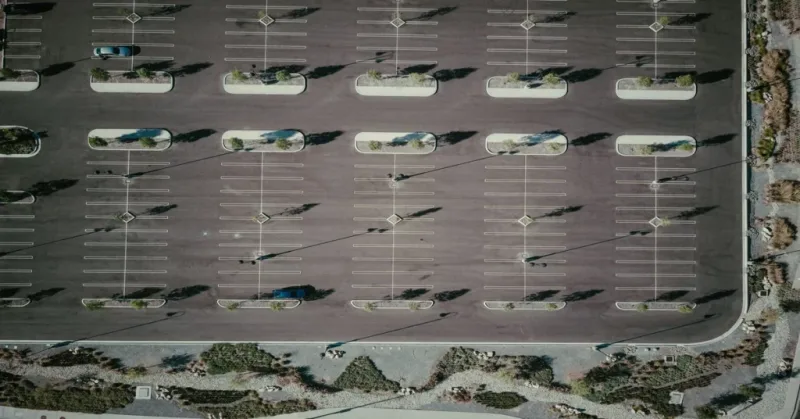
The best angle is usually an elevated oblique view: high enough to see over vehicles, but angled enough to show each space as a usable polygon. A straight horizontal view across a row may capture number plates or vehicle sides, but it may not show which exact space is occupied. A very steep view may show the layout well, but can make distant vehicles smaller.
A practical parking lot camera placement test is simple: open a representative image from the camera position and ask whether a person can mark each monitored space and judge its state confidently. If the answer is yes, the viewpoint is generally suitable for AI occupancy detection. If rows overlap, vehicles hide each other, or distant spaces cannot be separated, adjust the height, angle or number of cameras.
Typical coverage per camera
In normal outdoor mounting, a typical Parkinto installation covers 25–35 spaces per camera. With a high mounting point and a very good angle, coverage can be higher. The best-placed Parkinto camera, in Kutná Hora, covers about 100 spaces, but that is not the norm and should not be used as the standard planning assumption. Coverage is set by camera placement; there is no fixed limit.
For budgeting and early design, plan around the typical 25–35 spaces per camera range, then validate the exact layout with a real or proposed camera view. If you need licence plate recognition from the same camera, coverage changes significantly: a normal camera placed 4–8 metres from the spaces typically reads plates for 3–5 spaces. Occupancy coverage and licence plate reading have different optical requirements, so they should be planned separately.
| Placement decision | Practical recommendation | Why it matters |
|---|---|---|
| Height | Mount as high as practical; 5–6 m lighting poles are often ideal outdoors | Reduces occlusion and improves overview of rows |
| Angle | Use an elevated view where each monitored space is visible | Lets the system match vehicles to individual space polygons |
| Coverage | Expect 25–35 spaces per camera in typical outdoor layouts | Creates a realistic design and budget baseline |
| Licence plates | Plan closer views, typically 3–5 spaces per camera | Plate reading needs a different viewpoint from wide occupancy detection |
| Camera type | Use static IP/CCTV cameras, not PTZ cameras | Marked spaces must stay aligned with a fixed image |
Use static IP cameras and keep the image stable
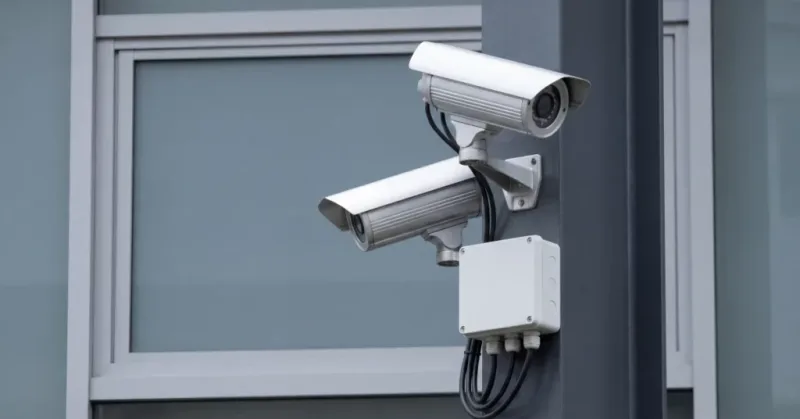
Parkinto works with almost any static IP/CCTV camera that can provide a snapshot URL or supported stream. Supported connection options include HTTP(S), FTP, RTSP, RTSP.me, MJPEG and YouTube live. The AI runs in the cloud, not inside the camera, so there is no need to install ground sensors, induction loops or on-site processing hardware beyond the camera itself.
PTZ cameras are not suitable for occupancy detection because pan, tilt or zoom changes the view. When the view moves, the polygons drawn over spaces no longer align with the real parking bays. For reliable operation, use a fixed camera position, a stable mount and a consistent view of the monitored area.
Resolution, lighting and weather
HD resolution can be sufficient for occupancy detection, while Full HD is better when vehicles are farther from the camera. The goal is not cinematic detail; it is a clear image where vehicles, rows and space boundaries can be distinguished. If the camera is covering distant spaces, a higher-resolution image gives the system more useful visual information.
At night, cameras should use their own IR illumination where needed. In rain, snow or fog, Parkinto works as long as the vehicles remain visible in the image. The same visual rule applies to partial obstruction: the system works when at least about half of the vehicle is visible. If part of a lot is regularly blocked by trees, signs, parked trucks or site equipment, add another viewpoint rather than trying to force one camera to cover everything.
When to use multiple cameras
Large and medium open areas are where camera-based detection is especially strong, but one camera does not have to do all the work. Multiple cameras can cover different rows, entrances to open areas, special parking zones or distant sections of the same site. If more than one camera sees the same space, Parkinto uses the camera view with the highest confidence.
This is useful for outdoor lots with irregular shapes, islands, trees, EV bays or truck areas. Instead of accepting a compromised view, use multiple fixed viewpoints and let each camera monitor the spaces it can see best.
Think about data use before final placement
Placement affects not only detection quality but also what the data can support. Parkinto Detection can provide live free/occupied state per space, stay length, time-limit highlighting, space types, a public web map for drivers, REST API access and webhooks. The Statistics add-on provides hourly aggregation, per-space data, stay length, turnover, arrivals, average and peak occupancy over time, exports and monthly summaries.
If the data will feed a public availability map, a parking guidance display, or an internal dashboard, prioritize a viewpoint that gives consistent per-space reporting. If licence plates are needed, Parkinto can read them and pass them through API or webhook to the customer’s own system; Parkinto does not store licence plates.
Parking lot camera placement checklist
- Use outdoor fixed IP/CCTV cameras with a stable view.
- Mount cameras high, ideally around 5–6 m where possible.
- Check that a human can see whether each target space is free or occupied.
- Plan typical coverage around 25–35 outdoor spaces per camera.
- Do not treat about 100 spaces from an ideal viewpoint as the standard case.
- Use closer camera positions when licence plate recognition is required.
- Avoid views where vehicles regularly hide each other.
- Use additional cameras for irregular areas, distant rows or occluded zones.
- Make sure the camera or recorder can be reached by the cloud, or can push images out.
- Validate the real image before finalizing the layout.
Privacy and compliance considerations
Camera placement should also support privacy-conscious operation. Parkinto does not archive images or video; only the latest image is kept for preview in the portal. Licence plates are not stored by Parkinto. Processing takes place in the EU, with operation in Czechia and Belgium, and GDPR compliance is confirmed by ÚOOÚ. Stay length and time limits can work without personal data.
Plan the view before you install
The best parking lot camera placement is usually decided before hardware is ordered or mounted. Start from the spaces, choose elevated fixed viewpoints, validate visibility from sample images, and use multiple cameras where that gives a cleaner result. This approach gives AI occupancy detection the information it needs without ground sensors or changes to the parking surface.
If you are planning parking lot camera placement for an outdoor site, Parkinto can help assess camera views and turn existing or new IP cameras into accurate, GDPR-compliant parking occupancy detection.